News
Results of the IHME Helsinki Impact Survey



Judging by responses to the survey conducted in April 2026, the main impact of IHME’s work is the production of new and different forms of public art that has broadened the understanding of what public art can be, and thus paved the way for others to be inspired and to revise their practices. Although the responses to the statement that IHME Helsinki promotes eco-social education and a sustainable lifestyle leaned slightly more towards a neutral stance than responses to other questions in the survey, the free-form responses to this section highlighted IHME’s role as a pioneer of ecological sustainability on the Finnish art scene.
The majority of survey respondents were newsletter subscribers, participants in IHME Helsinki Commissions and events, or active art enthusiasts or professionals in the field. Respondents had quite extensive experience of IHME’s works and events, starting with the IHME Contemporary Art Festival. Respondents also include some who had not participated in any of the activities.
Topical, unique, and surprising contemporary art
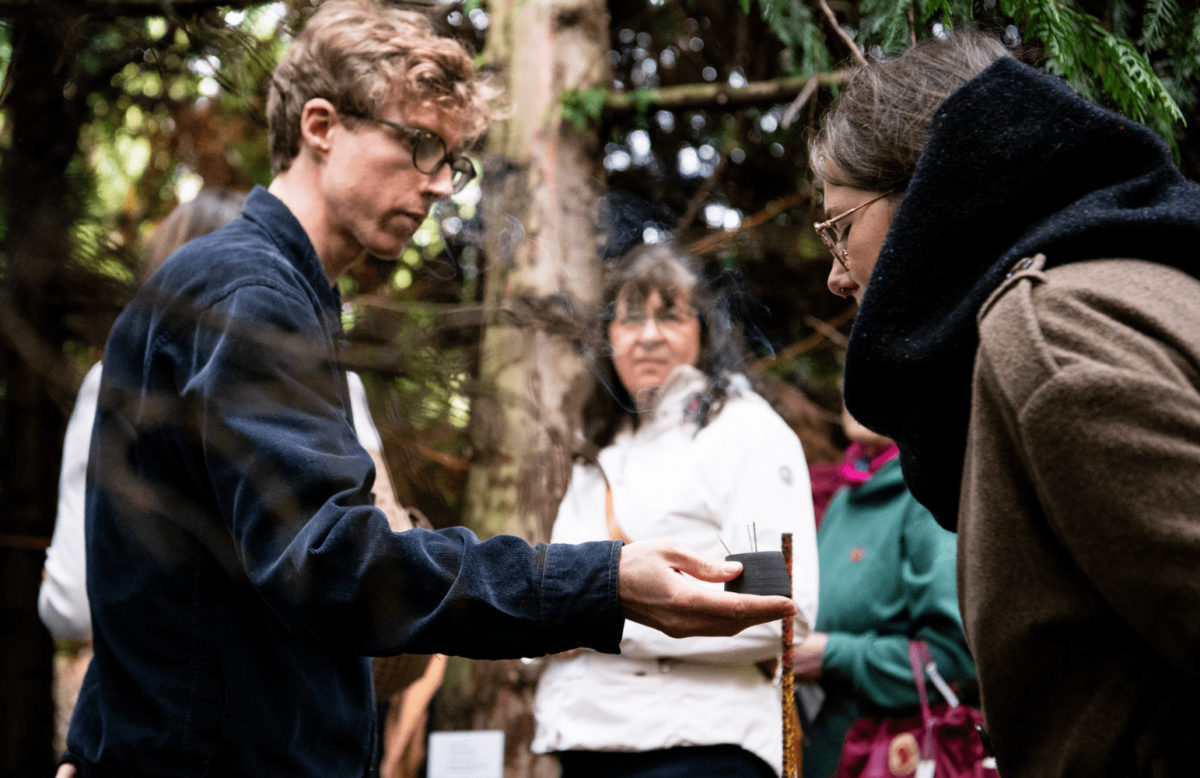
Respondents were asked to tell us about their experience of IHME Helsinki Commissions and events. In their free-form replies, they particularly mentioned the impact of the execution of the artworks, the topical issues they addressed, and their distinctiveness compared to other art on offer. Their experiences were described as memorable, profound, surprising, communal, and thought-provoking. A few vividly described how experiencing a work had influenced their own lives and ways of thinking. There was appreciation for the works’ varied locations and execution, free admission and accessibility to all, and especially for the opportunity to hold Katie Paterson’s To Burn, Forest, Fire ceremony themselves. The very first IHME project, Antony Gormley’s Clay and the Collective Body (2009), also continued to come up in the free-form responses as a powerful experience. There was perceived to be a need for community-oriented art, especially in these times.
Respondents also included some who took a critical view of IHME’s activities, seeing the artworks and events as aimed solely at the art community and modest in relation to the amount of work they had required or the Festival’s activities. At the same time, they mentioned in the survey that they had not participated in anything or that it had been a long time since their last participation.
Inspiration and general knowledge about the environment
In the survey respondents were also asked how the environmental information produced for IHME’s website has been used. For the most part, respondents had familiarized themselves with the news, curator’s articles, the Ecoblog, seminar and course recordings on the website, plus other videos on YouTube. The materials had served as an inspiration in their own work, for broadening their own thinking, for general knowledge, and for gaining additional information, as well as being applied to their own organization’s sustainability work. Some respondents also hoped that the information would, over time, influence their own thinking, actions, and consumption habits.
A key part of the survey was assessing IHME Helsinki’s impact in the following areas: contemporary art, audience engagement, eco-social education, and the promotion of a sustainable lifestyle, as well as internationality. Respondents were asked to indicate how much they agreed or disagreed with statements that had been formulated in advance.
Critical public art and new audiences
In assessing the overall significance of our work, respondents largely agreed that IHME has produced high-quality, critical public contemporary art in terms of both content and production, taken risks by presenting experimental art in public spaces, and broadened ideas of what public art can be.
Regarding audience engagement, respondents agreed with the statements that IHME’s work has made contemporary art more accessible to new audiences, promoted equality and a sense of community, offered experiences of togetherness, and brought together diverse audiences. Compared with the statements about contemporary art, those concerning audience engagement received slightly more neutral or “don’t know” responses.
Promoting eco-social education, sustainable lifestyles, and internationality
Regarding the promotion of eco-social education and sustainable lifestyles, respondents agreed that IHME has provided reliable environmental information to actors in the arts sector and demonstrated that art can be a form of social action. Respondents viewed IHME’s impact on making their own operations more ecologically sustainable, understanding the environmental impacts of their own operations, and environmental work in the workplace as significantly more neutral than they did other statements. A larger number of respondents also partially or totally disagreed with these statements than with those in other areas.
Combining the responses of those who partially and totally agreed, it can be conclude that, nevertheless, nearly half of respondents felt that our work had helped them understand the environmental impacts of their own activities. Of course, making their own activities more ecologically sustainable and engaging in environmental work at the workplace is influenced by many other factors besides experiencing the artworks or following IHME’s activities, so the split in the results in this regard is quite understandable.
With regard to internationality, respondents agreed that IHME’s work has promoted international dialogue in Finland, brought together domestic and international actors in art, research, and society, and enabled foreign artists to carry out long-term preparatory work. More than half of respondents were unable to comment on enabling the showing of IHME Helsinki works abroad, which is explained by the fact that the survey was primarily targeted at an audience residing in Finland.
The Impact of IHME Helsinki
Respondents were also asked to describe in their own words the impact of IHME Helsinki’s activities on them or on the arts organization they represent. In the free-form responses, the emphasis is on inspiring more sustainable practices in art-making and curation, as well as supporting these practices.
IHME Helsinki’s activities are also seen as an influential example of progressive collaboration between an art-commissioning organization and prominent artists, as well as being personally interesting, uplifting, and inspiring. The Commissions have introduced people to topics that they would not otherwise have encountered. Nevertheless, a few respondents criticized the fact that the artworks seemed to have a small number of participants and were aimed at a narrow target audience, so they felt that their impact remained very limited.
Finally, we asked whether IHME Helsinki had brought about lasting change. Respondents were given the opportunity to elaborate on their answers. Those who gave details of what lasting change might entail associated it, for instance, with opening up new discussions between the arts and other actors in society, functioning as a pioneer in ecologically sustainable artistic practice, and adding to sustainability themes and advocacy in the field, showing the way forward for public art, and creating space for others to do something comparable. On a personal level, lasting change was seen as related to broadening their own perspectives. Those who commented on the difficulty of answering the question noted that lasting impact can only be seen years later, and that the short duration of projects limits the ability of any impact to take root and spread.
In April, we invited everyone who follows and participates in our activities to respond to the IHME Helsinki impact survey. The aim of the survey was to determine how important our activities are overall and how successfully we have combined art, science, and climate work. A total of 152 visits were recorded for the survey, of which 79 were fully completed responses. Thank you to everyone who responded to the survey!