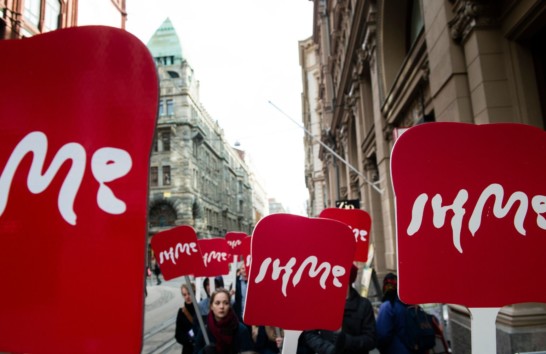
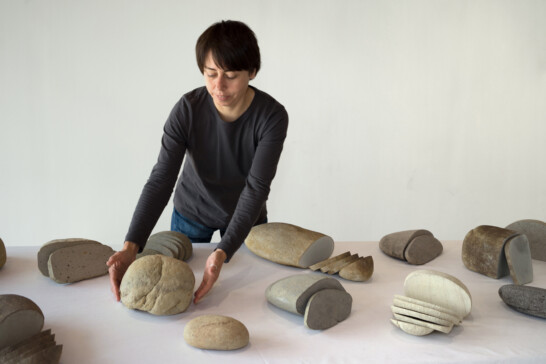
When Russia invaded Ukraine in February 2022, Kadyrova suspended her ongoing art projects, cancelled residencies, and rethought her artistic practice. She fled to the Carpathian Mountains, but realised that flight was not her solution and returned to her hometown of Kyiv a few months later. The Carpathians were, however, the birthplace of one of Kadyrova’s most famous series of works, PALIANYTSIA. This is a humanitarian artwork, and the proceeds from sales will be donated for the defence of Ukraine, to projects of Kadyrova’s choice in Ukraine. IHME Helsinki showed PALIANYTSIA at the Climate Security Festival at the Finnish Meteorological Institute on September 19–20, 2024 and at the Museum of Technology from October 29 to November 3, 2024.
“Palianytsia means bread. In a classical sense, it means a large, round wheat loaf baked in an oven. At the start of the war that Russia unleashed against Ukraine, the word “palianytsia” became a symbol, since Russian occupiers are unable to pronounce it correctly. It became a shibboleth, infallibly distinguishing friend from enemy. In addition to conventional troops, Russia sent groups of saboteurs to Ukrainian cities in advance of the invasion. The saboteurs’ task was to spy, inform Russia about where our armed forces were stationed, and where checkpoints and infrastructure facilities were located. They also left identifying marks to help aviation and landing forces navigate, and so on. These people moved around cities in civilian clothes, but were armed. The Palianytsia project was inspired by the Transcarpathian region, where my co-author Denis Ruban and I now live. At the start of the second week of the war, our whole family was forced to leave our hometown, Kyiv. My mother, sister and aunt are now in Germany, where we continue to live and hope to return. The villages here are protected by the Carpathian Mountains and there are many mountain rivers – their waters run fast and polish the stones. There are no strategic sites, such as airfields, military bases or weapons depots, here, so we think we are safe. Even though sometimes air-raid sirens sound. Upon arrival, we stayed in an overcrowded, expensive hotel in the regional centre. Trying to find our own place, we walked and travelled a lot around the area, and that was when we noticed the river stones. We started to look at them more closely and the idea just came to us. There was no time for distancing and analysis, just a growing need to do something and be useful! At the moment, there are about 6.5 million internally displaced persons in western Ukraine, so finding a place, especially one with a workshop, was incredibly difficult.
On the fifth day of our search, we succeeded! We found a detached house with no utilities, not even electricity, because a tree fell seven years ago and broke the wires. Together with the owners, we started organizing everything from scratch. Now we have electricity, Internet, a refrigerator and a microwave oven, firewood for cooking and heating the house, and water from a well. Most importantly, we can work. Being able to work on the project really helps us stay sane, because we feel that we are doing everything we can. We donate 100% of the money we receive for these artworks to volunteer organizations, and to friends who stayed in Kyiv and joined the Territorial Defense forces there. For the first two weeks of the war, it seemed to me that art was a dream, that all twenty years of my professional life were just something I had seen while asleep, that art was absolutely powerless and ephemeral in comparison to the merciless military machine destroying peaceful cities and human lives. Now, I no longer think so: I see that every artistic gesture makes us visible and makes our voices heard!”
Zhanna Kadyrova, 2022
Check out the work: kadyrova.com