Curator’s texts Essay
Curator’s Essay: The Forest
The Landscape of Our Time
The Great Meadow. The Kakhovka Sea. The Kakhovka Forest. Three names, but the same geographical area. They tell us about the transformations wrought by humans on that area at different times, first from meadow to sea, then from sea to forest. The Kakhovka Forest – the main character in Ukrainian artist Zhanna Kadyrova’s The Forest – became the starting point for our two-year collaboration on IHME Helsinki Commission 2025, which is now on display in The Power Station Museum.
It took a year for the Kakhovka Forest to grow on the site of the reservoir built on Ukraine’s biggest river, the Dnipro. The Kakhovka Dam, which was blown up in June 2023 as part of Russia’s war of aggression, contained an enormous reservoir. It was comparable in size to Finland’s second largest lake, Päijänne, which provides drinking water for over a million residents of the Helsinki region. The sudden release of water caused by the explosion resulted in a humanitarian and an environmental catastrophe, leaving more than 40 towns and villages – tens of thousands of people and animals – stranded by floodwaters. The drinking water supply and food security of more than 700,000 people – more than the entire population of Helsinki – were jeopardized.
In addition, pollutants that had settled at the bottom of the reservoir were released into the water, creating a long-lasting reserve of pollution that could be washed over an even wider area by future floods. Part of the area was land-mined during the war, making it unsuitable for human use and dangerous for numerous animal species. “A return to life or a toxic timebomb?” was part of the headline of an article published in The Guardian in July 2025 about the state of the forest that is the subject of Kadyrova’s work.
***
The construction of the dam 75 years ago was a violent act comparable in its impact on the area’s environmental diversity and cultural identity to bombing it. Construction began in 1950, at the end of Joseph Stalin’s (1878–1953) dictatorial reign, as part of his large-scale industrialization projects intended to ensure the Soviet Union’s self-sufficiency. Technological progress was combined with a grandiose exercise of power, the local people’s culture being worthless in Stalin’s eyes. An immeasurable portion of the region’s cultural history and artifacts was buried under the huge reservoir. According to archaeological research, the area has been inhabited for more than two thousand years and is particularly known as the cradle of Cossack culture in the 16th–18th centuries. Part of the area’s history has been preserved on Khortytsia – the largest island in the Dnipro River, in the city of Zaporizhzhia – where the natural and cultural heritage of the area is safeguarded by Khortytsia Museum.
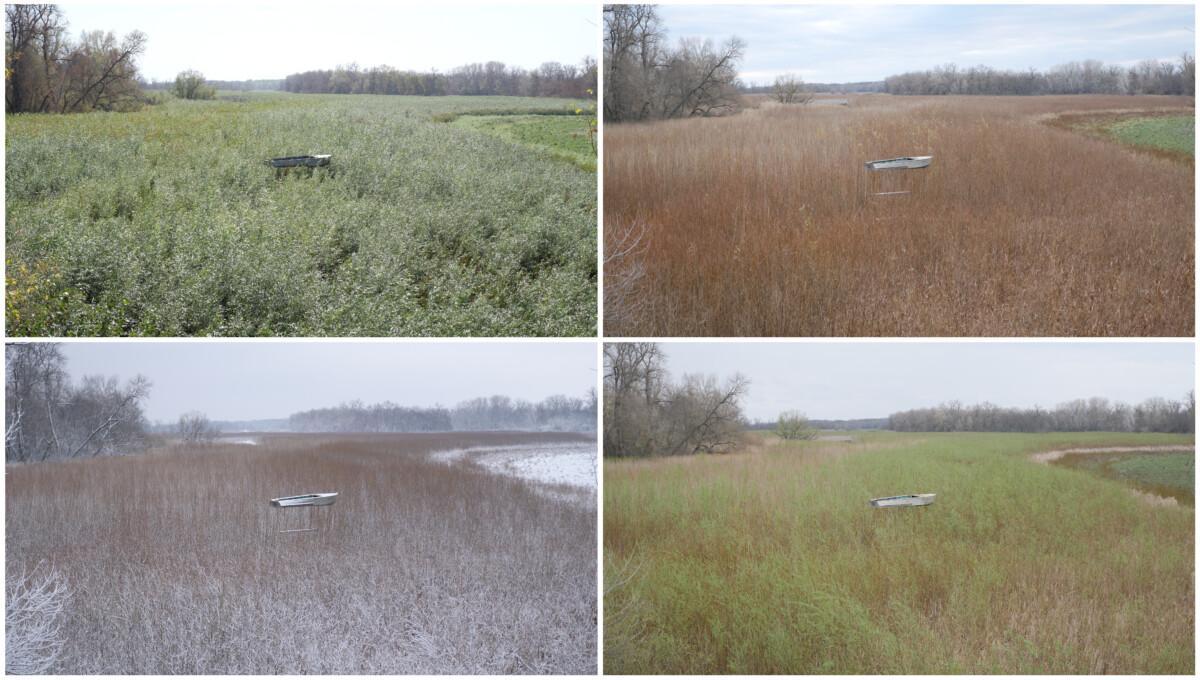
The Kakhovka reservoir covered over a large forest and swamp ecosystem called Velykyi Luh, or Great Meadow. In June of 2023, the reservoir was emptied out, and just one year later, the two-year-old forest depicted in Kadyrova’s work had grown in its place. This is a demonstration of the power of nature, as the willows and poplars that had been shed as seeds that sank to the bottom of the reservoir, grew to a height of three to four metres in just a year, forming the largest floodplain forest on the Ukrainian steppe. The forest has grown than human beings could ever have achieved in the same time. Numerous plant and animal species are roaring back to the former reservoir area, but the drought brought about by climate change and plans to rebuild the dam threaten the area’s future.
***
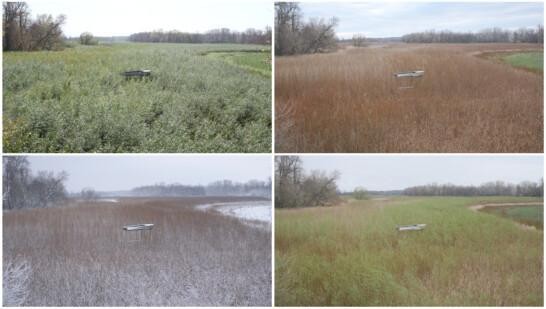
Kadyrova’s decision to remain in her homeland after the start of the war and her desire to see the scars of war with her own eyes powerfully influenced the creation of this commissioned work. My suggestion to look into the environmental aspect of the war was reinforced when the artist had seen the landscape revealed beneath the “Kakhovka Sea” and its complex future. The main character of the exhibition turned out to be an extensive, wooded area, the Kakhovka Forest. Her first artistic act in this landscape was to bring in a boat and raise it to the height of the former water level of the Sea. Time became a significant factor, as did recording the unusually rapid growth of nature, with the boat serving as a poetic measure of this. The ambitious goal was to film the forest on regular basis for a year. This was particularly challenging because the Kakhovka Forest is partly in a warzone. In the end, a safer location for filming was found only 27 kilometres from the frontline. With the help of many friends and local people, Kadyrova achieved her goal and was able to capture some of the second year of the young forest’s life, from autumn to summer. The camera obscura images of the forest’s growth, shown in the exhibition, were made in July of this year.
The exhibition features video footage taken by the artist of the forest that has grown on the site of the reservoir, at different times of the year and of day, and projected onto opposite walls. Amid the trees swaying in the wind we can see a boat floating at the height of the treetops and at the water level of the reservoir that once stood in the same place. The boat is simultaneously a symbol of humanity, a measure of the forest’s exceptional vitality, and a monument to the area’s past as the “Kakhovka Sea” – the locals’ name for the reservoir – as it gradually disappears under the forest. On the opposite wall, the boat travels through time from morning to dusk, through nighttime and dawn, in a succession of moonlight, fog, sunrises, and sunsets. The exhibition is like condensed time, a cyclical image of a landscape where past and future utopias and dystopias simmer ominously.
***
The past, present, and speculative futures are not only there in the videoworks, but also in the documents laid out on an oval table, showing the cruel history of the dam’s construction on the Dnieper and its tributaries, which are known in Ukrainian culture as a symbol of the cycle of nature. In collaboration with the Visual Culture Research Center/Kyiv Biennial and the Oleksandr Dovzhenko National Centre, we have been loaned research data, maps, photographs, and video documentation depicting the fate of those caught up in the flood as a result of the war – all from The River Wailed Like a Wounded Beast exhibition shown in Kiev in 2023. A propaganda film documenting the construction of the dam, made during the Stalin era by film director Oleksandr Dovzhenko, after whom the centre is named, has been given a new interpretation in the hands of the artist Mykola Bazarkin. The human-generated cycle of violence forces people to leave their homes and nature to seek new forms, from meadow to sea, from sea to forest, over and over again.
Throughout the ages, as enablers of food production, good transport connections, and trade, waterways have attracted human communities to establish villages and towns along their shores. The site for Kadyrova’s work, the Power Station Museum, is the spot where the City of Helsinki was founded in the 1550s, now known as Vanhankaupunginkoski (old town rapids). The story told by the Museum, which has been closed for some twenty years, can still be explored through the plaques on its walls, which invite visitors to reflect on one stratum of history, and the narrative of progress. But what does the future hold for the environments defined by these energy infrastructures, and how does progress manifest itself in our time?
A battle is being fought on two fronts over the future of the Kakhovka Dam. There are good reasons for rebuilding the dam and the reservoir: they would meet the drinking water and agricultural-irrigation needs of southern Ukraine. If the dam is restored to its former state, the repair work would take about five years. It would mean that the forest would once again be submerged and the nascent, largely unexplored ecosystem would disappear. In Helsinki, meanwhile, the City Council made a decision in 2022 to demolish Vanhankaupunginkoski Dam because of the area’s natural value: they want the migratory fish – the salmon and trout – which have disappeared from the river, to return.
Nature values are also under discussion in Ukraine. According to the 2025 UWEC (Ukrainian War Environmental Consequences Work Group) report, from a climate perspective, this new forest ecosystem offers significant opportunities for carbon dioxide capture and storage. “This is an opportunity we cannot afford to miss,” says Eugene Simonov, international coordinator of the Rivers without Boundaries Coalition, in the July 2025 Guardian article. “If Ukraine chooses to protect Velykyi Luh, it won’t just be saving a landscape, it will be choosing to believe in its own future.” To which Oleksiy Vasyliuk, co-author of the UWEC’s 2025 report on the reservoir and head of the Ukrainian Nature Conservation Group adds:
“This is our biocultural sovereignty at stake and that means our nature, our identity, our independence, and a symbol of the kind of nation we want to become.”
The main characters in Kadyrova’s Commission are two of our planet’s life-sustaining systems: forests and waterways. The third main character is humankind, whose actions have endangered both of these life-sustaining systems, not just in the case study presented in the Commission, but on a planetary scale. The Forest conveys a powerful image of a landscape, a nation, and humanity at a crossroads where the potentials for both utopias and dystopias exist simultaneously. Nevertheless, the unusual vitality of the forest depicted by Kadyrova also offers hope for reconstruction, both post-war and ecologically.
***
For the time being, the cycle of life in the Forest is still determined by nature and nature’s laws. The lives of plants and animals are guided by a knowledge of how to sustain life. It is the human species whose boat is in danger of sinking. But if we vanish into the forest like a boat, we may still have hope.
Helsinki, August 17, 2025
Paula Toppila, Executive Director, Curator, IHME Helsinki
Acknowledgments:
City of Zaporizhzhya
Khortitsa Museum, Zaporizhzhya
Oleksandr Dovzhenko National Centre, Kyiv
City of Helsinki
Museum of Technology, Helsinki
Numerous private individuals in Zaporizhzhya and Kiev.
Enablers of our work 2023–2025: Saastamoinen Foundation, Kone Foundation, Abakanowicz Art and Culture Charitable Foundation
References:
Kahovka Dam, wikipedia. https://en.wikipedia.org/wiki/Destruction_of_the_Kakhovka_Dam#
https://www.hsy.fi/vesi-ja-viemarit/nain-vesihuolto-toimii/paakaupunkiseudun-vesi/
Translated with deepl.com (free version), revised by MG.