Ecoblog
IHME Helsinki’s carbon footprint 2025

As part of our commitment to sustainable development and transparency, we publish an annual report on the carbon footprint of our operations. In this report we detail the main sources of emissions and their distribution, and assess our progress in reducing our environmental impact. We once again fell well short of our 2025 target of 25.3 t CO2e, which would match our emission-reduction path. At the heart of IHME Helsinki’s operations is the desire to bring about positive change, always taking into account the emission impacts of our activities.

Summary of our carbon footprint for 2025
In 2025, IHME Helsinki’s total emissions were approximately 15.7 t CO2e. This is less than the average annual emissions of two Finns. We reduced our carbon footprint slightly from 2024 (15.8 CO2e), even though we included more emissions in the calculation than last year. This year, emissions resulting from marketing are also included more comprehensively than previously.

Sources of emissions
Once again, travel was our biggest source of emissions. Travel emissions related to IHME Helsinki 2025 accounted for 65.6% of the artwork’s emissions and for 82.3% of our total emissions. These emissions also include those calculated for accommodation. Emissions from our other activities came almost entirely (94.9%) from travel. We travel by land whenever possible, but, occasionally, time constraints and distances make flying hard to avoid.
Not all of last year’s trips went as planned, due to flight cancellations or missed connecting flights, which increased travel and accommodation emissions. To get the full picture we have included the additional emissions caused by these factors in our emissions calculations. To minimize emissions from accommodation we favour hotels that are committed to ecological values.
Our energy consumption consisted solely of emissions for IHME Helsinki Commission 2025, since our office building uses renewable, carbon-free energy. Carbon-footprint calculators often do not count these forms of energy as sources of emissions. In reality, even these “emission-free sources” produce emissions. There is no such thing as emission-free activity.
Carbon-footprint calculators rely on estimates that often do not take into account lifecycle emissions, but focus only on a specific portion of total emissions. Lifecycle emissions take a more comprehensive view of emissions, ranging from the procurement of raw materials for production to the final dismantling and recycling of the product. You can see a comparison of carbon-footprint calculators in our previous blog post.
It is also important to remember that renewable and carbon-free forms of energy also have broader impacts on our environment. Procurement of raw materials, construction, and modification of the environment always have an impact on the environment at the expense of living nature.
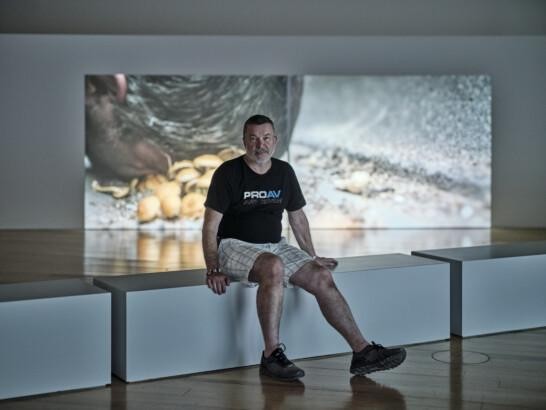
The emissions from the energy consumption for IHME Helsinki Commission 2025 accounted for 7.4% of our total emissions and for 17.3% of the emissions associated with the artwork itself. The Commission was exhibited for just over a month at the Power Plant Museum owned by the City of Helsinki. The Museum has its own electricity contracts through the City, and heating costs are fixed throughout the year. As tenants of the space we were unable to influence the forms of energy used. Pro Av Saarikko Oy, which was responsible for the video installation, uses products from companies committed to responsibility, and their energy efficiency has been taken into account.
Our third largest source of emissions was services and events, accounting for 10.2% of our total emissions. A more significant source of emissions was marketing (1.2 t CO2e), followed by emissions from internet and telephone connections (0.35 t CO2e). The marketing of the Commission was done via outdoor advertising, a radio campaign, and social-media advertising. Consumption due to marketing also includes the making of signs and signage to aid venue visibility.
When producing marketing materials, we try to choose partners who are also committed to responsibility, take their emissions into account, and comply with the requirements of a responsibility certificate, such as EcoCompass. But those choices are always weighed against the reality that not all companies have their responsibility issues in order yet. Niini Oy, JCDecaux, and Bussimainos were selected as partners for marketing materials and outdoor advertising, with Niini and JCDecaux taking responsibility and emissions into account extensively in their operations.
We took social media advertising consumption into account in our calculations, but our digital footprint, which is affected by our other activities on social media and our website, is not included in the calculations. We have also not considered audience travel for IHME Helsinki Commission 2025. We encourage visitors to take public transport, and the locations of our artworks are chosen to be easily accessible by public transport.
We actively monitor these areas to find new ways of reducing emissions.
Our climate goals and Future outlook
Our goals are in line with Finland’s national climate goals, and we aim to increase the share of more sustainable modes of travel, such as trains instead of flying. This is not, however, always possible when our artists come from far away.
Although our carbon footprint is relatively small compared to many organizations, all our emissions are significant and are taken into account. IHME Helsinki is committed to transparency, continuous learning, and promoting a responsible environmental culture. We can influence our total emissions with careful planning that uses advance estimates of our carbon footprint. We want to encourage and inspire others to investigate the impact of their own activities on nature and to continue to expand our carbon (/environmental) handprints, together.
Ines Oreschnikoff
Eco-coordinator
Translated with DeepL.com (free version) Revised by MG